If you are planning to buy a 1000 litre IBC tank, the first question is usually simple: “How much does it hold?”
But for an industrial buyer, that is rarely enough.
The purchase team may want the price. The warehouse team wants to know how much floor space it will take. The transport team needs its dimensions and loaded weight. And the operations team wants to know whether the tank, cage, pallet and outlet arrangement will work for the intended application.
That is why understanding 1000 litre IBC tank dimensions, weight, capacity and specifications before ordering can save a lot of trouble later.
This guide explains the practical numbers and, more importantly, what those numbers actually mean when you are selecting an IBC tank.
Quick 1000 Litre IBC Tank Specification Overview
A common 1000 litre IBC uses approximately the following dimensions:
| Specification | Typical Value |
|---|---|
| Nominal Capacity | 1000 litres |
| Approx. Length | 1200 mm |
| Approx. Width | 1000 mm |
| Approx. Height | Around 1150–1175 mm |
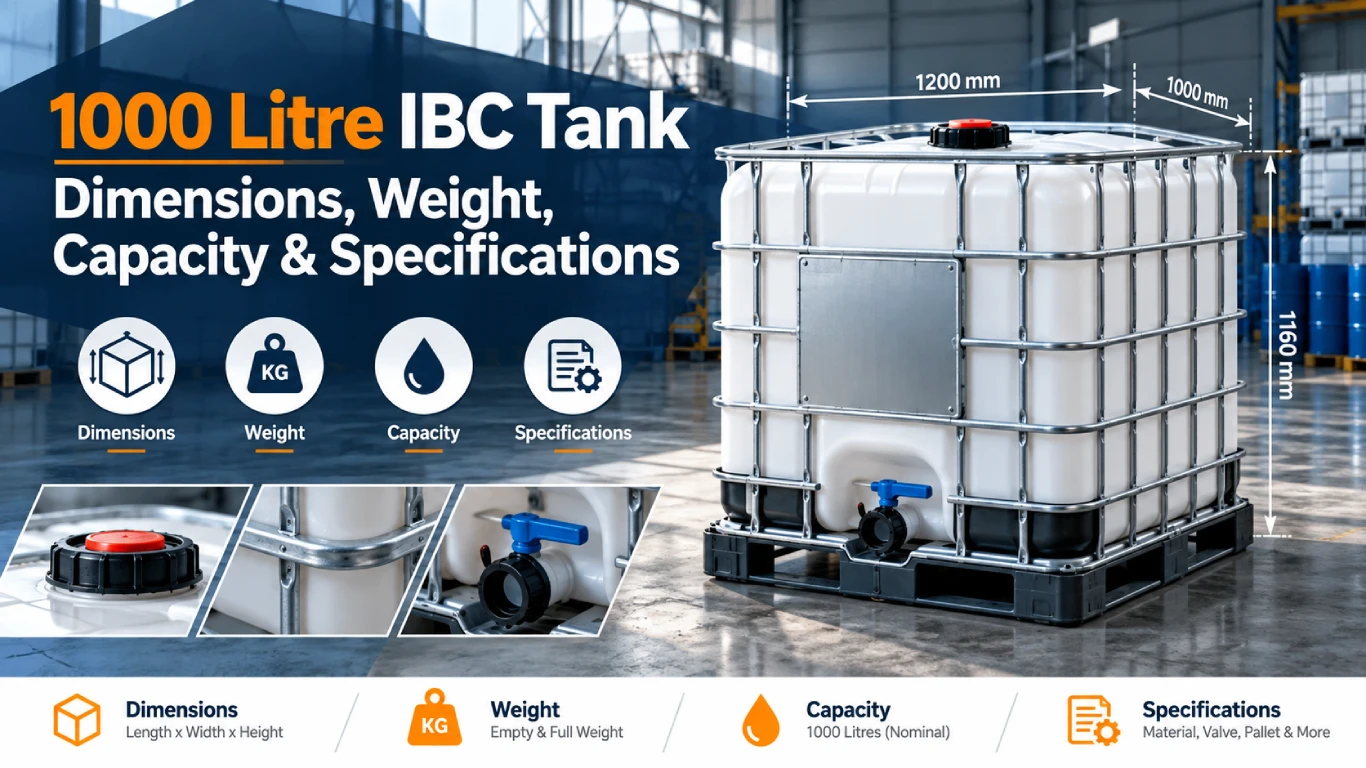
| Common Reference Size | Around 1200 × 1000 × 1160 mm |
| Empty Weight | Usually varies by tank, cage and pallet design |
| Filled Weight With Water | More than 1 tonne including container |
| Inner Container | Typically HDPE |
| Outer Protection | Metal cage |
| Base | Plastic, metal, composite or other pallet design depending on model |
| Shape | Rectangular / cube-style |
| Common Use | Bulk liquid storage and handling |
A frequently referenced standard dimension is approximately 1200 × 1000 × 1160 mm, although exact measurements differ between manufacturers and IBC designs.
This variation is important.
If your warehouse rack, filling station, transport vehicle or process area has tight clearance, always check the actual product specification instead of assuming every 1000L IBC has exactly the same external dimensions.
What Are the Dimensions of a 1000 Litre IBC Tank?
A standard-sized 1000 litre IBC tank is generally around 1200 mm long and 1000 mm wide, with a height close to 1160 mm.
In simple terms, that means roughly:
Length: 1.2 metres
Width: 1 metre
Height: approximately 1.15–1.18 metres
The 1200 × 1000 mm footprint is one of the reasons IBC tanks are so practical for industrial storage.
Instead of using several smaller drums to store the same quantity of liquid, a business can handle close to one cubic metre of product within a relatively compact pallet-sized footprint.
For a busy industrial facility, that can make handling, storage and material movement much more organised.
Are all 1000 litre IBC tank dimensions the same?
No.
This is one detail buyers sometimes overlook.
Two IBC tanks may both have a nominal capacity of 1000 litres but still have slightly different:
- overall height
- pallet construction
- outlet position
- top opening
- cage design
- base design
- tare weight
Current product listings, for example, show 1000L tanks with heights around 1150, 1153, 1160 and 1175 mm depending on the product.
For general planning, standard dimensions are useful.
For final procurement, use the specification of the exact IBC being supplied.
What Is the Capacity of a 1000 Litre IBC Tank?
As the name suggests, its nominal liquid capacity is:
1000 litres
That is approximately:
1 cubic metre of liquid volume.
This large capacity is one of the biggest advantages of an IBC.
Imagine managing the same volume using much smaller containers. You would have more individual units to count, move, arrange and handle.
An IBC consolidates a large amount of liquid into one handling unit.
This is why these containers are commonly considered for bulk industrial liquid handling, manufacturing, processing and supply-chain operations.
But there is an important distinction between tank capacity and how much a particular liquid should actually be filled into that tank.
The correct filling conditions depend on factors such as:
- liquid characteristics
- density
- temperature
- container specification
- regulatory requirements
- transport requirements
- supplier recommendations
So “1000 litre capacity” should not automatically be interpreted as permission to put any liquid into any 1000L IBC.
Always match the IBC specification to the intended product.
How Much Does an Empty 1000 Litre IBC Tank Weigh?
There is no single empty weight that applies to every IBC.
A commonly seen tare weight is roughly in the 50–65 kg range, although some designs and listings can differ significantly depending on their cage, pallet and construction. Current market listings show examples around 50 kg, 57 kg and 65 kg.
Why does the weight change?
Because an IBC is not just a plastic bottle.
The complete assembly may include:
- HDPE inner bottle
- steel cage
- top filling cap
- discharge valve
- corner protection
- pallet or base
- identification plates
- supporting components
Change the base from one material to another and the tare weight can change.
Change the cage construction and it can change again.
That is why procurement teams should ask for tare weight instead of searching for one universal “IBC tank weight” figure.
How Much Does a Full 1000 Litre IBC Weigh?
This is where things become more important for warehouse and transportation planning.
For water, a useful calculation is:
1000 litres of water ≈ 1000 kg
Then add the weight of the IBC itself.
So if an empty unit weighs approximately 55 kg:
Approximate loaded weight = 1000 kg + 55 kg = 1055 kg
In other words, a 1000 litre IBC filled with water can weigh more than one tonne.
A standard reference source similarly gives approximately 1055 kg for a 1000L IBC filled with water when using an approximately 55 kg empty container.
But don’t use 1055 kg for every liquid.
The correct calculation is:
Filled Weight = Empty IBC Weight + (Liquid Volume × Liquid Density)
For example, a liquid with a different density from water will produce a different loaded weight.
This matters when planning:
- forklift capacity
- warehouse flooring
- pallet racking
- vehicle payload
- loading arrangements
- stacking
- internal material movement
A common mistake is checking whether the forklift can lift the empty container.
The number that really matters is the maximum loaded weight.
Understanding the Construction of a 1000L IBC Tank
Most people notice the plastic inner container first.
But the performance of an IBC depends on the complete structure working together.
HDPE Inner Container
Many common IBC designs use a high-density polyethylene inner bottle.
It forms the primary liquid-holding portion of the IBC.
Its cube-like design helps make efficient use of space compared with round containers.
Protective Metal Cage
The outer cage provides structural support and protection around the inner container.
It also gives the IBC its familiar industrial appearance.
When purchasing a used, refurbished or reconditioned unit, the cage condition should not be treated as cosmetic.
Look for obvious deformation, damaged weld areas, severe corrosion or other signs that should be evaluated before use.
Pallet Base
The base makes mechanical handling considerably easier.
Depending on the model, an IBC may use different pallet constructions.
The base design can influence:
- weight
- handling
- durability
- transport suitability
- operating environment
When comparing two 1000 litre IBC tanks, don’t compare only the bottle.
Compare the complete assembly.
Why Is the 1200 × 1000 mm Footprint Important?
A 1000 litre IBC provides a large amount of liquid storage within roughly 1.2 square metres of floor footprint using the common 1200 × 1000 mm reference dimensions.
For industrial users, this can make warehouse planning easier.
You can estimate:
- how many units fit in a defined floor area
- aisle requirements
- loading space
- receiving area requirements
- approximate storage density
However, warehouse planning should never be done using footprint alone.
You also need to consider:
- total height
- filled weight
- access for handling equipment
- safe clearances
- manufacturer stacking limitations
- operating conditions
Ten tanks fitting geometrically into an area does not automatically mean that area is designed to safely store ten loaded tanks.
1000 Litre IBC Tank vs 200 Litre HDPE Drums
For buyers comparing bulk packaging options, this is one of the most practical comparisons.
To reach 1000 litres of nominal capacity, you would need approximately:
5 × 200 litre drums
compared with:
1 × 1000 litre IBC
That doesn’t automatically make the IBC better.
It depends on how the product is handled.
A 1000L IBC may be useful when:
- larger volumes are consumed at one location
- fewer individual containers are preferred
- pallet handling is available
- bulk filling or dispensing is required
- floor utilisation matters
200 litre drums may make more sense when:
- smaller batches are required
- material must be split between locations
- individual units need to be moved separately
- usage volume is lower
The correct choice depends on the operation rather than simply choosing the biggest container.
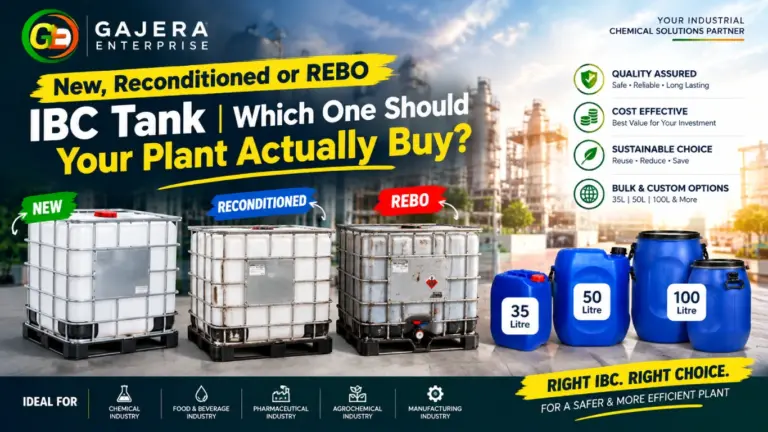
New, Reconditioned or Refurbished 1000L IBC?
Another question buyers regularly face is whether they need a new IBC or whether a reconditioned/refurbished option can meet their requirement.
The answer should depend on the application.
New IBC Tanks
A new tank may be preferred where the application or buyer specification requires a new container or specific certification/configuration.
Reconditioned or Refurbished IBC Tanks
These can be relevant in applications where an appropriately processed reusable container is suitable.
However, buyers should understand exactly what has been replaced, inspected or processed.
Don’t rely only on terms such as:
“used”
“refurbished”
“reconditioned”
“REBO”
Ask the supplier what the product configuration actually includes.
A lower purchase price is useful only when the container is suitable for the intended application.
What Should You Check Before Buying a 1000 Litre IBC Tank?
A good procurement enquiry should include more than:
“1000 litre IBC price?”
That question may get you a quotation, but it doesn’t necessarily get you the right product.
Before placing an order, confirm:
- Nominal capacity
Confirm that the required size is actually 1000 litres.
- External dimensions
Ask for the exact length, width and height of the supplied model.
- Tare weight
This matters for transport and loaded-weight calculations.
- Pallet type
Check which base configuration is supplied.
- Cage condition and construction
Especially important when considering reusable units.
- Top opening
Confirm the filling arrangement required for your process.
- Outlet valve
Make sure the outlet configuration suits your dispensing system.
- Tank condition
Clarify whether the unit is new, used, refurbished, reconditioned or another specified configuration.
- Intended liquid
Tell the supplier what you plan to store rather than assuming compatibility.
- Quantity required
Bulk quantity can affect availability, freight and commercial pricing.
The more specific your enquiry is, the easier it becomes for the supplier to recommend the right option.
How to Calculate Space for Multiple IBC Tanks
Suppose a facility needs space for 20 units.
Using the common footprint:
1.2 m × 1.0 m = approximately 1.2 m² per IBC
The simple container footprint would therefore be:
20 × 1.2 = approximately 24 m²
But this does not mean you should reserve only 24 m².
Real warehouse planning must also account for:
- aisles
- forklift movement
- inspection access
- loading clearance
- safety requirements
- separation requirements
- operational space
The calculation is useful for early planning, not as a complete warehouse design.
Why Exact IBC Specifications Matter for Procurement
IBC tanks can look almost identical in photographs.
That sometimes creates the impression that they are interchangeable.
They are not always.
Small differences in:
- height
- valve type
- pallet
- cage
- tank construction
- certification
- condition
- previous use
- compatibility
can make a major difference once the container reaches your plant.
A better purchasing approach is to start with the application and work backwards.
Instead of asking:
“Which IBC is cheapest?”
ask:
“Which IBC specification fits our liquid, handling system, storage setup and operating requirement?”
Price still matters.
But it becomes one part of the buying decision rather than the entire decision.
Frequently Asked Questions
What are the standard dimensions of a 1000 litre IBC tank?
A commonly referenced 1000 litre IBC tank size is approximately 1200 × 1000 × 1160 mm (L × W × H). Exact dimensions can vary by manufacturer, pallet and model.
How tall is a 1000 litre IBC?
Many 1000L IBC tanks are approximately 1.15–1.18 metres high, although exact height varies between products. Current listings show examples around 1150–1175 mm.
What is the capacity of an IBC tank?
A standard large IBC commonly used in industrial applications has a nominal capacity of 1000 litres.
How much does an empty 1000 litre IBC weigh?
The empty or tare weight varies by construction. Common market examples can fall around the 50–65 kg range, although different products may be lighter or heavier.
How much does a 1000 litre IBC weigh when full?
If filled with approximately 1000 litres of water, the liquid alone weighs about 1000 kg. Add the tare weight of the container, so the total can exceed 1,050 kg depending on the IBC. For other liquids, calculate using the liquid’s density.
Are all 1000L IBC tanks the same size?
No. Capacity may be the same while external height, tare weight, valve, cage and pallet configuration differ.
Can a 1000L IBC be moved with a forklift?
IBC pallet bases are designed around mechanical handling, but the handling equipment must be suitable for the actual loaded weight and specific container configuration. Follow the supplier’s and equipment manufacturer’s requirements.
Final Thoughts
A 1000 litre IBC tank may look like a straightforward industrial container, but its dimensions and specifications affect almost every stage of its use—from purchasing and transportation to storage, filling and dispensing.
As a practical starting point, many standard 1000L units are around:
1200 mm long × 1000 mm wide × approximately 1160 mm high
with a nominal capacity of :
1000 litres
But those figures should be treated as reference values, not a substitute for the exact product specification.
Before placing an order, confirm the required capacity, exact dimensions, tare weight, pallet, cage, outlet configuration, condition and intended application.
Looking for a 1000 Litre IBC Tank?
If your business is sourcing 1000 litre IBC tanks, new IBC tanks, reconditioned IBC tanks, REBO IBC tanks or related industrial containers, contact Gajera Enterprise with your required quantity and application.
Sharing the product requirement, location, quantity and preferred configuration at the enquiry stage can help identify a more suitable option and provide a more relevant quotation.
Need Help Choosing the Right Industrial Solution?
Tell us about your application, required quantity and technical requirements. Our team can help you explore suitable product options.