
1000 Litre IBC Tank Dimensions, Weight, Capacity & Specifications
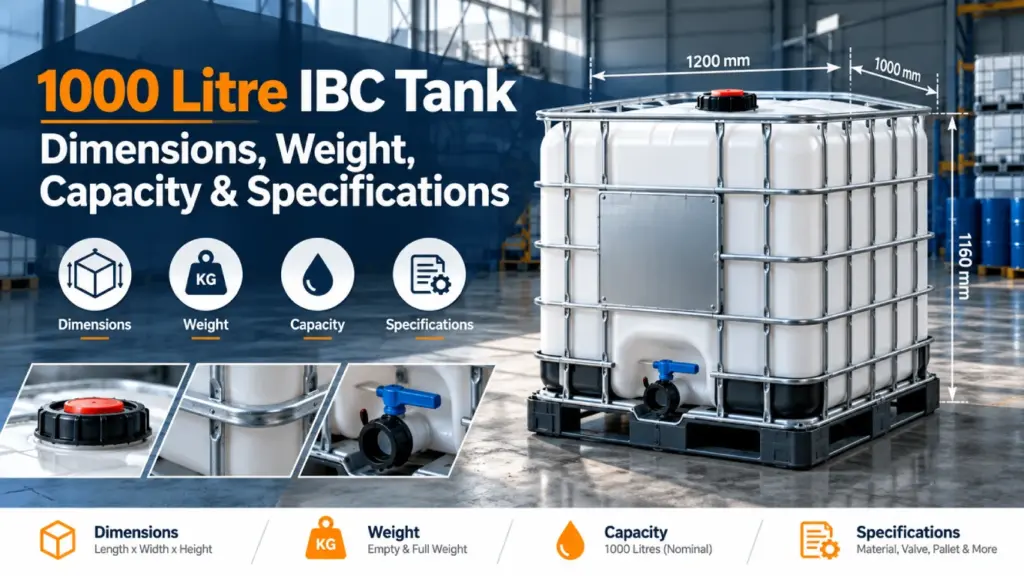
If you are planning to buy a 1000 litre IBC tank, the first question is usually simple: “How much does it hold?” But for an industrial buyer, that is rarely enough. The purchase team may want the price. The warehouse team wants to know how much floor space it will take. The transport team needs its dimensions and loaded weight. And the operations team wants to know whether the tank, cage, pallet and outlet arrangement will work for the intended application. That is why understanding 1000 litre IBC tank dimensions, weight, capacity and specifications before ordering can save a lot of trouble later. This guide explains the practical numbers and, more importantly, what those numbers actually mean when you are selecting an IBC tank. Quick 1000 Litre IBC Tank Specification Overview A common 1000 litre IBC uses approximately the following dimensions: Specification Typical Value Nominal Capacity 1000 litres Approx. Length 1200 mm Approx. Width 1000 mm Approx. Height Around 1150–1175 mm Common Reference Size Around 1200 × 1000 × 1160 mm Empty Weight Usually varies by tank, cage and pallet design Filled Weight With Water More than 1 tonne including container Inner Container Typically HDPE Outer Protection Metal cage Base Plastic, metal, composite or other pallet design depending on model Shape Rectangular / cube-style Common Use Bulk liquid storage and handling A frequently referenced standard dimension is approximately 1200 × 1000 × 1160 mm, although exact measurements differ between manufacturers and IBC designs. This variation is important. If your warehouse rack, filling station, transport vehicle or process area has tight clearance, always check the actual product specification instead of assuming every 1000L IBC has exactly the same external dimensions. What Are the Dimensions of a 1000 Litre IBC Tank? A standard-sized 1000 litre IBC tank is generally around 1200 mm long and 1000 mm wide, with a height close to 1160 mm. In simple terms, that means roughly: Length: 1.2 metresWidth: 1 metreHeight: approximately 1.15–1.18 metres The 1200 × 1000 mm footprint is one of the reasons IBC tanks are so practical for industrial storage. Instead of using several smaller drums to store the same quantity of liquid, a business can handle close to one cubic metre of product within a relatively compact pallet-sized footprint. For a busy industrial facility, that can make handling, storage and material movement much more organised. Are all 1000 litre IBC tank dimensions the same? No. This is one detail buyers sometimes overlook. Two IBC tanks may both have a nominal capacity of 1000 litres but still have slightly different: Current product listings, for example, show 1000L tanks with heights around 1150, 1153, 1160 and 1175 mm depending on the product. For general planning, standard dimensions are useful. For final procurement, use the specification of the exact IBC being supplied. What Is the Capacity of a 1000 Litre IBC Tank? As the name suggests, its nominal liquid capacity is: 1000 litres That is approximately: 1 cubic metre of liquid volume. This large capacity is one of the biggest advantages of an IBC. Imagine managing the same volume using much smaller containers. You would have more individual units to count, move, arrange and handle. An IBC consolidates a large amount of liquid into one handling unit. This is why these containers are commonly considered for bulk industrial liquid handling, manufacturing, processing and supply-chain operations. But there is an important distinction between tank capacity and how much a particular liquid should actually be filled into that tank. The correct filling conditions depend on factors such as: So “1000 litre capacity” should not automatically be interpreted as permission to put any liquid into any 1000L IBC. Always match the IBC specification to the intended product. How Much Does an Empty 1000 Litre IBC Tank Weigh? There is no single empty weight that applies to every IBC. A commonly seen tare weight is roughly in the 50–65 kg range, although some designs and listings can differ significantly depending on their cage, pallet and construction. Current market listings show examples around 50 kg, 57 kg and 65 kg. Why does the weight change? Because an IBC is not just a plastic bottle. The complete assembly may include: Change the base from one material to another and the tare weight can change. Change the cage construction and it can change again. That is why procurement teams should ask for tare weight instead of searching for one universal “IBC tank weight” figure. How Much Does a Full 1000 Litre IBC Weigh? This is where things become more important for warehouse and transportation planning. For water, a useful calculation is: 1000 litres of water ≈ 1000 kg Then add the weight of the IBC itself. So if an empty unit weighs approximately 55 kg: Approximate loaded weight = 1000 kg + 55 kg = 1055 kg In other words, a 1000 litre IBC filled with water can weigh more than one tonne. A standard reference source similarly gives approximately 1055 kg for a 1000L IBC filled with water when using an approximately 55 kg empty container. But don’t use 1055 kg for every liquid. The correct calculation is: Filled Weight = Empty IBC Weight + (Liquid Volume × Liquid Density) For example, a liquid with a different density from water will produce a different loaded weight. This matters when planning: A common mistake is checking whether the forklift can lift the empty container. The number that really matters is the maximum loaded weight. Understanding the Construction of a 1000L IBC Tank Most people notice the plastic inner container first. But the performance of an IBC depends on the complete structure working together. HDPE Inner Container Many common IBC designs use a high-density polyethylene inner bottle. It forms the primary liquid-holding portion of the IBC. Its cube-like design helps make efficient use of space compared with round containers. Protective Metal Cage The outer cage provides structural support and protection around the inner container. It also gives the IBC its familiar industrial appearance. When